 A collaborative team of Marian University faculty, students, and recent alumni from the Leighton School of Nursing (LSON) and the Wood College of Osteopathic Medicine (WCOM) has earned national recognition for innovative educational research designed to strengthen clinical communication and patient care.
The team was named a 2025 Interprofessional Education & Practice (IPEC) Poster Fair Winner at the Interprofessional Education Collaborative (IPEC) 2025 Virtual Poster Symposium, where their work was voted strongest by attendees in the Simulation: Clinical & Person-Care Focused breakout room.
The award-winning poster, “SBAR Simulation Helps Enhance Communication Between Osteopathic Medicine Students and Bachelor’s Nursing Students,” highlights Marian’s interdisciplinary approach to preparing future healthcare professionals for real-world clinical environments.
Showcasing Marian’s Commitment to Team-Based Care
The research was presented by Callie Runyon ’25, Leighton School of Nursing alumna, and Lauryn San Juan (OMS-2), a student in Marian’s Wood College of Osteopathic Medicine. The Marian team was one of 49 interprofessional groups selected from across the United States and several other countries.
Faculty collaborators and co-authors Dr. Brian Skinner, Dr. Emily Young, and Kerri Irwin, associate professor in Marian University’s Leighton School of Nursing, also attended the symposium and supported the student presenters.
Additional co-authors Baleigh Norman (OMS-3) and Teya Cassaday ’25, LSON alumna, contributed to the design and development of the poster but were unable to attend the event.
From Classroom Simulation to National Stage
The featured SBAR (Situation, Background, Assessment, Recommendation) simulation is housed within NSG 451: Clinical Immersion and is completed by all LSON and WCOM students. The simulation provides hands-on, structured opportunities for nursing and osteopathic medicine students to practice clear, effective communication—an essential skill in clinical settings.
The team also presented the research during Marian University Research Day, reinforcing Marian’s commitment to applied scholarship and collaborative learning.
Student Spotlight: Learning Together to Lead in Practice
Callie Runyon ’25 said, “Working through real clinical scenarios with osteopathic medicine students helped strengthen my confidence and communication skills in a way that feels directly applicable to patient care.”
Lauryn San Juan (OMS-2) added, “Interprofessional collaboration is essential in clinical practice. This project reinforced how important it is to communicate clearly, respect each team member’s role, and work together for the best patient outcomes.”
Advancing Marian’s Mission Through Interprofessional Education
Faculty leaders noted that national recognition from IPEC affirms the strength of Marian University’s interprofessional education model.
“This recognition speaks to the intentional collaboration between LSON and WCOM faculty and the dedication of our students. It’s a powerful example of how interdisciplinary learning at Marian prepares graduates for collaborative, compassionate clinical practice.”
This interdisciplinary collaboration between LSON and WCOM faculty and students to better prepare our students for clinical practice is innovative and a clear example of the type of impactful educational research that will transform learning in our professions.
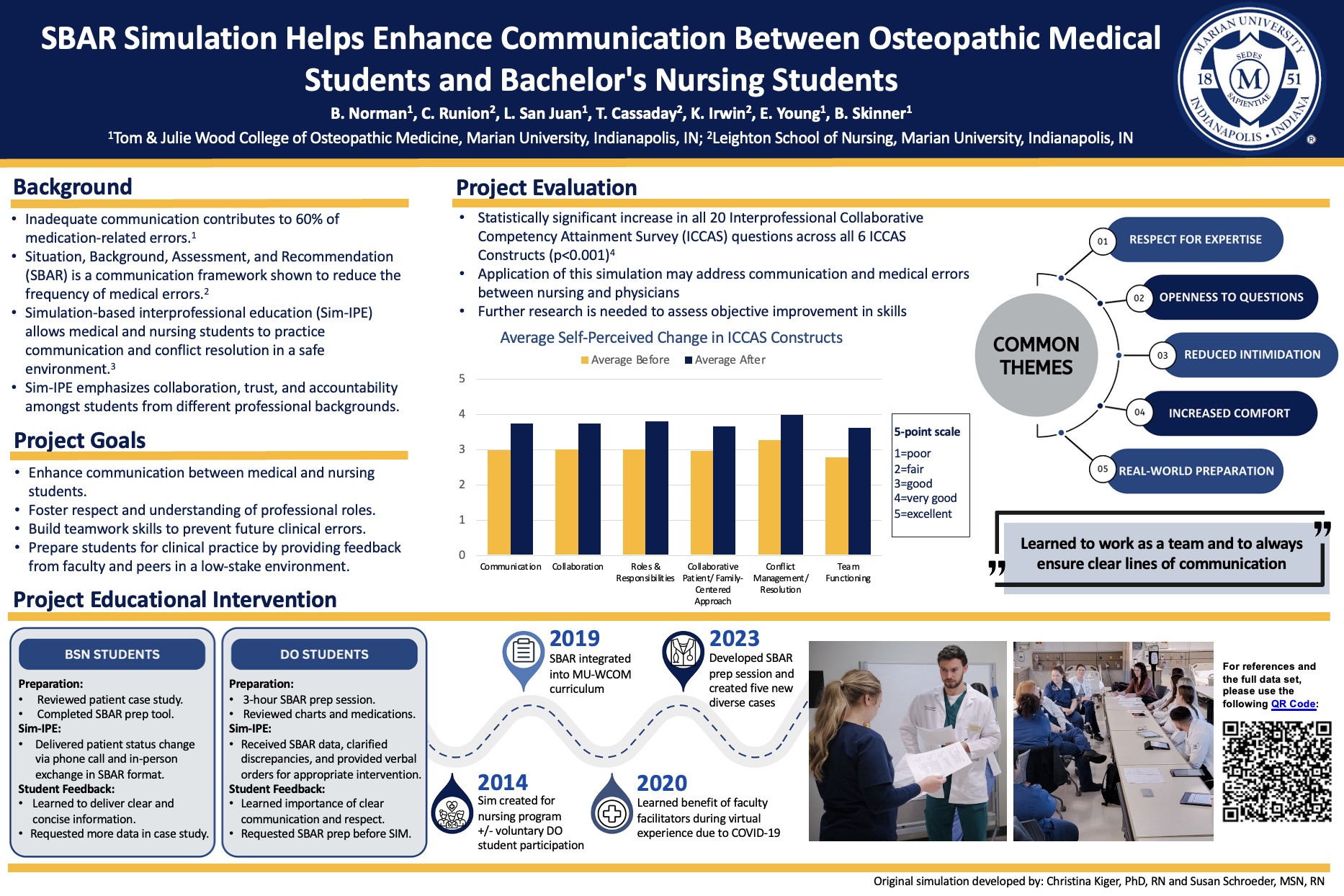
SBAR Simulation Helps Enhance Communication Between Osteopathic Medical Students and Bachelor's Nursing Students
Background
- Inadequate communication contributes to 60% of medication-related errors.¹
- Situation, Background, Assessment, and Recommendation (SBAR) is a communication framework shown to reduce the frequency of medical errors.²
- Simulation-based interprofessional education (Sim-IPE) allows medical and nursing students to practice communication and conflict resolution in a safe environment.³
- Sim-IPE emphasizes collaboration, trust, and accountability amongst students from different professional backgrounds.
Project Goals
- Enhance communication between medical and nursing students.
- Foster respect and understanding of professional roles.
- Build teamwork skills to prevent future clinical errors.
- Prepare students for clinical practice by providing feedback from faculty and peers in a low-stake environment.
Project Evaluation
- Statistically significant increase in all 20 ICCAS questions across all 6 ICCAS Constructs (p<0.001)⁴
- Application of this simulation may address communication and medical errors between nursing and physicians
- Further research is needed to assess objective improvement in skills
Common Themes
Timeline
Sim created for nursing program +/- voluntary DO student participation
SBAR integrated into MU-WCOM curriculum
Learned benefit of faculty facilitators during virtual experience due to COVID-19
Developed SBAR prep session and created five new diverse cases
Explore Related Links
- Hill-Rom Simulation Center overview – Core hub describing interprofessional training and experiential learning in a safe environment.
- Facilities details (Wood College of Osteopathic Medicine) – Highlights simulation labs for immersive, risk-free clinical training.
- Facility and Equipment page – Details task trainers and hybrid simulations emphasizing communication skills.
- ABSN Simulation Labs – Focuses on hands-on scenarios with manikins for critical thinking and patient care.
- Leighton School of Nursing – Program home tying to compassionate, faith-based nursing education.
- Wood College of Osteopathic Medicine – Overview of interprofessional collaboration and facilities.
- AI in Medicine blog post – Related content on AI's role, for cross-linking to show balanced tech/human approach.